
Quick answer
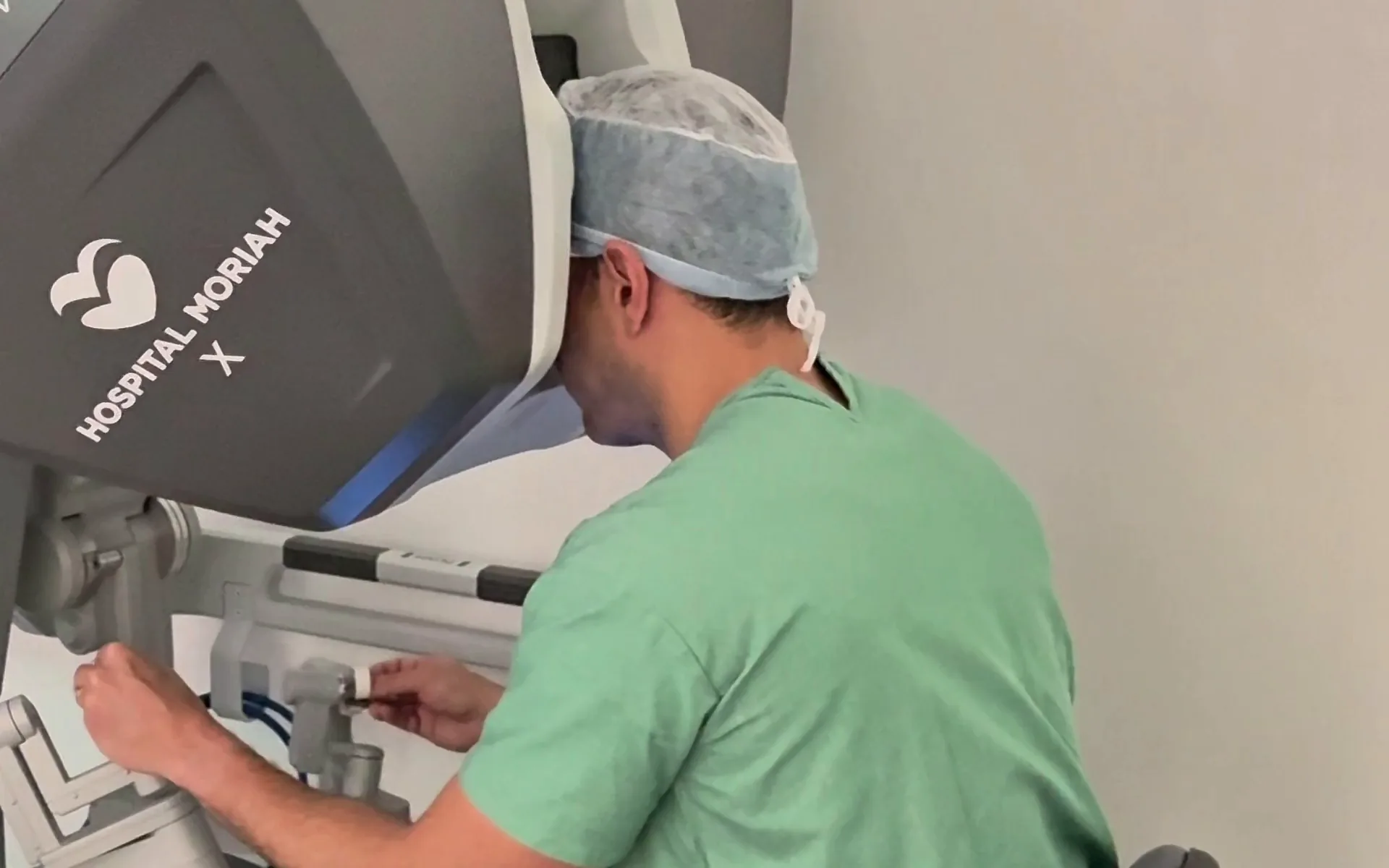
A pyeloplasty corrects the narrowing at the junction between the renal pelvis and the ureter, called ureteropelvic junction obstruction. The narrowing makes it hard for urine to drain and dilates the kidney. In the standard Anderson-Hynes technique, the narrow segment is removed and the ureter is sewn back to the renal pelvis. The European guideline reports success in about 95% of cases. In my practice, I operate on children and adults with the robot. The hospital stay is under 24 hours, the catheter comes out before discharge, I do not use a drain and the double-J stent stays for 1 month.
What ureteropelvic junction obstruction is
Urine leaves the kidney through the renal pelvis and travels down the ureter to the bladder. When the passage between the pelvis and the ureter is narrow, urine builds up and the kidney dilates, which is called hydronephrosis. In children, it is often first seen on a prenatal ultrasound. In adults, it may show up as flank pain or on a scan done for another reason.
When surgery is recommended
The European paediatric urology guideline recommends surgery when the obstruction is confirmed by symptoms or by repeated tests showing loss of kidney function.1 The signs that weigh in the decision are:1
- Flank pain that keeps coming back, or a urinary tract infection with fever
- Function of the affected kidney below 40% of the total
- A drop of more than 10 points in that function from one test to the next
- Poor urine drainage on a diuretic renal scan
- Increasing dilatation on ultrasound
Dilatation alone does not always mean surgery is needed.1 In adults, the decision also takes symptoms and kidney function tests into account, case by case.
How the operation is done
- AccessThe robot's instruments go in through small cuts, and the surgeon finds the junction between the renal pelvis and the ureter.
- Removing the narrow segmentThe narrow segment is cut out.
- Sewing it backThe ureter is sewn to the renal pelvis with a wide opening for urine to pass.
- Double-J stentA thin tube, the double-J stent, stays inside, from the kidney to the bladder, while the stitches heal.
Robotic, laparoscopic or open
The European guideline considers the dismembered Anderson-Hynes technique the gold standard. In children, open, laparoscopic and robotic surgery had comparable success and complication rates, and minimally invasive surgery had a shorter hospital stay, less pain and faster recovery.1
In adults:
- A review comparing robotic and laparoscopic surgery found fewer complications and higher success with the robot. The authors question whether the difference matters in practice.2
- At one center, robotic pyeloplasty had a 90.6% success rate, similar to laparoscopic surgery, with a shorter hospital stay and longer operating time.3
The double-J stent
In my practice, I always leave a double-J stent, without a string, for about 1 month. It is removed in the operating room, under sedation. While it is in place, it may cause frequent urge to urinate, burning and blood in the urine. The double-J stent page explains these symptoms.
Risks
Risks include bleeding, urinary tract infection, urine leaking from the stitches, discomfort from the double-J stent and the narrowing coming back, which may need further treatment. The European guideline reports success in about 95% of cases with the dismembered technique.1
Recovery and follow-up
In my practice, the hospital stay is under 24 hours, the catheter is removed before discharge and I do not use a drain. Light work resumes after about 2 weeks and strenuous effort after 1 month. Follow-up tests, a renal scan and an ultrasound, are done 6 months after surgery.
How I approach it
I operate on children and adults, with the robot and the dismembered technique. Before surgery, I go over the imaging and kidney function tests with the patient, or with the family, and explain what to expect. The decision is made together.
When to see a urologist
- If an ultrasound showed a dilated kidney, in a child or an adult
- If you have flank pain that keeps coming back, or a urinary tract infection with fever, and a scan showed narrowing between the kidney and the ureter
- If you already need surgery and want to know about the robotic approach
Frequently asked questions
What is a pyeloplasty?+
It is the operation that corrects the narrowing at the junction between the renal pelvis and the ureter. In the dismembered Anderson-Hynes technique, the narrow segment is removed and the ureter is sewn back to the renal pelvis.1
Does the operation usually work?+
The European guideline reports success in about 95% of cases with the dismembered technique.1 In some cases the narrowing comes back and may need further treatment.
How long will I stay in hospital?+
In my practice, the hospital stay is under 24 hours. The urinary catheter is removed before discharge, and I do not use a drain.
Will I have a double-J stent?+
Yes. In my practice, I always leave a double-J stent, without a string, for about 1 month. It is removed in the operating room, under sedation.
Can a child have robotic surgery?+
Yes. The European guideline says open, laparoscopic and robotic surgery have comparable success and complication rates in children, including infants, with longer operating time in minimally invasive surgery.1 I operate on children and adults.
References
- EAU Guidelines on Paediatric Urology. European Association of Urology; 2026. Chapter on dilatation of the upper urinary tract (PUJ obstruction). EAU
- Light A, Karthikeyan S, Maruthan S, et al. Peri-operative outcomes and complications after laparoscopic vs robot-assisted dismembered pyeloplasty: a systematic review and meta-analysis. BJU Int. 2018;122(2):181-194. BJU International
- Carmona O, Dotan ZA, Haifler M, et al. Laparoscopic Versus Robot-Assisted Pyeloplasty in Adults-A Single-Center Experience. J Pers Med. 2022;12(10):1586. PubMed
Would you like to talk about your case?
In the consultation, I go over your tests and your priorities.
Book a consultation