
Quick answer
In a partial nephrectomy, only the tumor is removed, with a margin of healthy tissue. In a radical nephrectomy, the whole kidney is removed. For tumors up to 7 cm, the European guideline recommends the partial, because cancer control is comparable and it preserves kidney function better.1 Radical nephrectomy, preferably laparoscopic or robotic, is for larger tumors and for those that cannot be treated with a partial.1 In my practice, I perform both with the robot, with a hospital stay under 24 hours.
What each operation removes
In a partial nephrectomy, the tumor is removed with a margin of healthy tissue, the area is sutured and the rest of the kidney keeps working. In a radical nephrectomy, the whole kidney is removed together with the tumor.1

Side by side
| Item | Partial | Radical |
|---|---|---|
| What is removed | The tumor, with a margin of healthy tissue | The whole kidney, with the tumor |
| When the European guideline recommends it | T1 tumors, up to 7 cm; T2 tumors with a solitary kidney or chronic kidney disease, if feasible | T2 tumors and those that cannot be treated with a partial |
| Kidney function below 60 at 6.7 years | 65% | 86% |
| Complications | Slightly more frequent | Slightly less frequent |
| Hospital stay, in my practice | Under 24 hours | Under 24 hours |
| Catheter and drain, in my practice | Catheter removed before discharge; no drain in most cases | No catheter and no drain |
Kidney function comes from the European randomized trial, in people whose other kidney was normal. A filtration rate below 60 already counts as moderate chronic kidney disease. It was more common after radical nephrectomy. The more severe loss, below 30, was 10.0% after radical and 6.3% after partial, and kidney failure was almost the same, 1.5% and 1.6%.4 The slightly higher complication rate of the partial also comes from this trial.1
What the studies show
The only randomized trial compared the two operations in 541 people with a tumor up to 5 cm and a normal other kidney, with 9.3 years of follow-up.3 Both had excellent cancer results: only 12 of the 117 deaths were from the disease. Overall survival at 10 years was 81% after radical and 76% after partial nephrectomy, but among those who actually had kidney cancer, the difference was no longer significant.3 The trial closed early because too few patients enrolled, and the European guideline considers this question unresolved.1
The American guideline gives priority to the partial for T1a tumors, up to 4 cm, and sets criteria for choosing the radical, to avoid both too many radicals and risky partials.2
For larger tumors, 4 to 7 cm (T1b) and above 7 cm (T2), there is no randomized trial. A review of 21 studies, with more than 11,000 patients, found better kidney function and fewer recurrences after the partial, with more complications.5 The people who had the partial were younger and had smaller tumors, which affects these numbers. For T2 tumors, complications of the partial were twice as common, and the authors recommend a more selective use of the partial in this group.5
Why radical nephrectomy is done by laparoscopy or robot
Compared with open surgery, laparoscopic radical nephrectomy had a shorter hospital stay, less need for pain medication and faster recovery, with no difference in survival.1 Robotic radical nephrectomy, also compared with open surgery, had a shorter hospital stay, fewer complications and less bleeding.1
The European guideline also says that, for a T1 tumor, a feasible partial should not be replaced by a radical just to do the operation by laparoscopy or robot.1
How I approach it
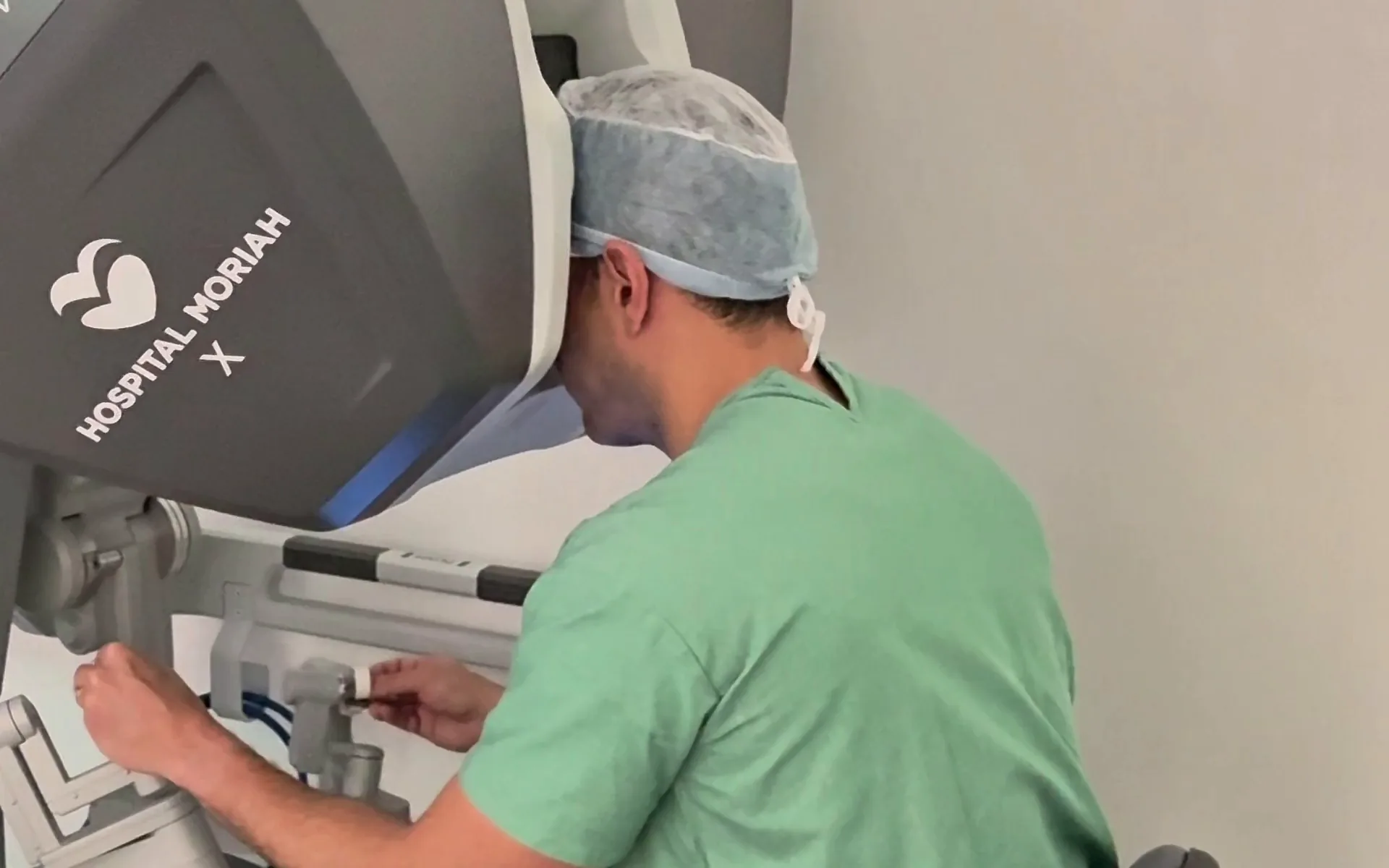
I perform both operations with the robot. The choice depends on the size and position of the tumor, the function of both kidneys and your general health. I assess this on the scans before surgery and decide together with each patient.
In my practice, the hospital stay is under 24 hours for both. After a partial, the catheter comes out before discharge and most cases need no drain. After a radical, I use no catheter and no drain.
When to see a urologist
- If a scan showed a kidney mass
- If you have been told to have the kidney removed and want to know if it can be saved
- If you have a solitary kidney, chronic kidney disease or tumors in both kidneys
- If you want a second opinion before surgery
Send your case
If you have a kidney tumor and would like my opinion on your case before a consultation, fill in the form below and, if you can, attach your CT or MRI report. It goes to my office, and you will get a reply within 24 hours by email or WhatsApp. The form does not replace a consultation: it helps plan the next step.
Frequently asked questions
What is the difference between partial and radical nephrectomy?+
In a partial nephrectomy, only the tumor is removed, with a margin of healthy tissue, and the rest of the kidney stays. In a radical nephrectomy, the whole kidney is removed with the tumor.1
Does partial nephrectomy control the cancer as well as radical?+
For T1 tumors, up to 7 cm, the European guideline considers the cancer outcomes of partial nephrectomy comparable to those of radical, and partial nephrectomy preserves kidney function better. That is why it is the treatment of choice in these cases.1
When is partial nephrectomy not possible?+
The size and position of the tumor can rule out a partial nephrectomy. The European guideline recommends laparoscopic or robotic radical nephrectomy for T2 tumors, larger than 7 cm, and for those that cannot be treated with a partial.1 This is assessed on the scans before surgery.
Can you live well with one kidney?+
In general, yes. In the European randomized trial, in people whose other kidney was normal, kidney failure was rare and almost the same after both operations, 1.5% and 1.6%. Moderate loss of function was more common after radical nephrectomy.4
What is recovery like after robotic radical nephrectomy?+
In my practice, the hospital stay is under 24 hours, as with the partial, and I use no catheter and no drain.
References
- EAU Guidelines on Renal Cell Carcinoma. European Association of Urology; 2026. Disease management chapter. EAU
- Campbell SC, Clark PE, Chang SS, et al. Renal Mass and Localized Renal Cancer: Evaluation, Management, and Follow-Up: AUA Guideline: Part I. J Urol. 2021;206(2):199-208. AUA
- Van Poppel H, Da Pozzo L, Albrecht W, et al. A prospective, randomised EORTC intergroup phase 3 study comparing the oncologic outcome of elective nephron-sparing surgery and radical nephrectomy for low-stage renal cell carcinoma. Eur Urol. 2011;59(4):543-52. PubMed
- Scosyrev E, Messing EM, Sylvester R, et al. Renal function after nephron-sparing surgery versus radical nephrectomy: results from EORTC randomized trial 30904. Eur Urol. 2014;65(2):372-7. PubMed
- Mir MC, Derweesh I, Porpiglia F, et al. Partial Nephrectomy Versus Radical Nephrectomy for Clinical T1b and T2 Renal Tumors: A Systematic Review and Meta-analysis of Comparative Studies. Eur Urol. 2017;71(4):606-617. PubMed
Would you like to talk about your case?
In the consultation, I go over your tests and your priorities.
Book a consultation5.0186 Google reviews